
Raised Without Boundaries? Read This.
Ever felt like your needs are too much, or your feelings are an inconvenience? If so, it’s not your fault, and you aren’t the problem. You’re responding to a childhood curriculum you never chose, but had to graciously accept.
Many survivors of emotional neglect, or subtle abuse, carry a wound that rarely gets named: self-abandonment. Not because they weren’t loved, but because love was conditionally offered. Attention, validation, and affection came with an unspoken rule: put your needs last, abandon what you want, and you might get what you need.
This led to adaptation. And understanding it is the first step to reclaiming yourself.
The Lesson You Never Signed Up For
As a child, you learned quickly. The message didn’t need to be explicit. It lived in the eye-roll and head snap when you expressed a need. And in the blank stares and silence when you shared a feeling. Also in the words “You ungrateful 他妈的 ! I brought you into this world, the least you could do is…”
What you absorbed was this: your needs are inconvenient. Your emotions are a burden. You’re simply “too much” and wanting things is selfish.
So you learned to anticipate what others needed before they asked, and that safety meant you had to shrink.
This is what therapists call the fawn response: the trauma-driven strategy of people-pleasing, accommodating, and forfeiting yourself to maintain connection. It’s the flip side of fight-or-flight, and for survivors of emotional neglect, it’s often the default.
When Childhood Becomes Adulthood
The problem is, those adaptations worked. Well… sort of.
They kept you safe(ish) when you were dependent on people who made you feel like your needs were too much to ask. But now you’re grown, and those same patterns are quietly wrecking your relationships with yourself.
You might notice it in these ways:
- You over-explain yourself, hoping someone will finally understand.
- You say “yes” when you feel like saying “no,” then feel resentful or depleted.
- You apologize for things that don’t require an apology.
- You people-please, then wonder why you feel invisible in return.
- You confuse boundaries with abandonment, fearing that saying no means no one will love you.
The cruel irony? The very strategies that helped you survive childhood are now the thing keeping you from thriving as an adult.
Building Boundaries from the Inside Out
External boundaries like saying no, speaking up, or leaving a conversation are useless if your internal voice is screaming that “you don’t deserve to…” Real boundary-setting starts as an inside job.
Here are some practical steps to begin that work:
1. Name the pattern without shaming yourself
Awareness is everything. When you notice yourself over-explaining, people-pleasing, or shrinking, pause and name it. “I’m fawning right now.” “I’m abandoning myself because I feel like I have to in order to keep this relationship.” Naming it breaks the automatic pilot and puts you back in the driver’s seat.
2. Give yourself permission
Permission is the antidote to shame. You don’t need anyone’s approval to want things. You don’t need to justify your needs. Write it down if you have to: I am allowed to want things. I am allowed to say “no.” My needs are not inconvenient. They are mine.
3. Start with small no’s
You don’t have to rebuild your entire boundaries overnight. Practice saying no to something low-stakes. Order what you actually want to eat. Tell a friend you can’t meet this time. Each small no rebuilds the muscle of trusting yourself.
4. Notice the body, not just the mind
Self-abandonment lives in the body. A tight chest. A throat that closes. A pit in your stomach. A knot in your solar plexus. When you learn to read those signals, when you can say “this is my body telling me I’m abandoning myself,” you gain a powerful early warning system.
5. Rewire the inner critic
The voice that says “your needs are too much” was programmed by someone who couldn’t meet your needs. That voice is not truth. It’s an echo. When it speaks, counter it with something grounded: I survived by adapting but I’m older now, and I will HONOR my needs and chose people who will, too.
You Were Not the Problem
If there’s one thing to take from this, let it be this: there’s nothing wrong with you. There was something toxic done to you.
Your needs weren’t too much and your feelings were not inconvenient. The void you felt wasn’t a flaw in you; It was a gap left by people who couldn’t show up. The self-abandonment you learned as a child was a survival strategy. Returning to yourself as an adult is reclamation.
You don’t have to do this alone. Find your people. Be picky. Make sure they deserve your presence. You are a gift!
A Free Resource for Your Healing Journey
If this piece resonated with you and you want additional support in navigating childhood emotional neglect, self-abandonment, and people-pleasing, I’ve created a free eBook for you.
Why You Keep Explaining Yourself to People Who Don’t Hear You offers practical tools and reflective prompts to help you recognize the patterns, rebuild your relationship with yourself, and start setting boundaries that protect your peace… without shame.
You deserve to take up space. You always did.
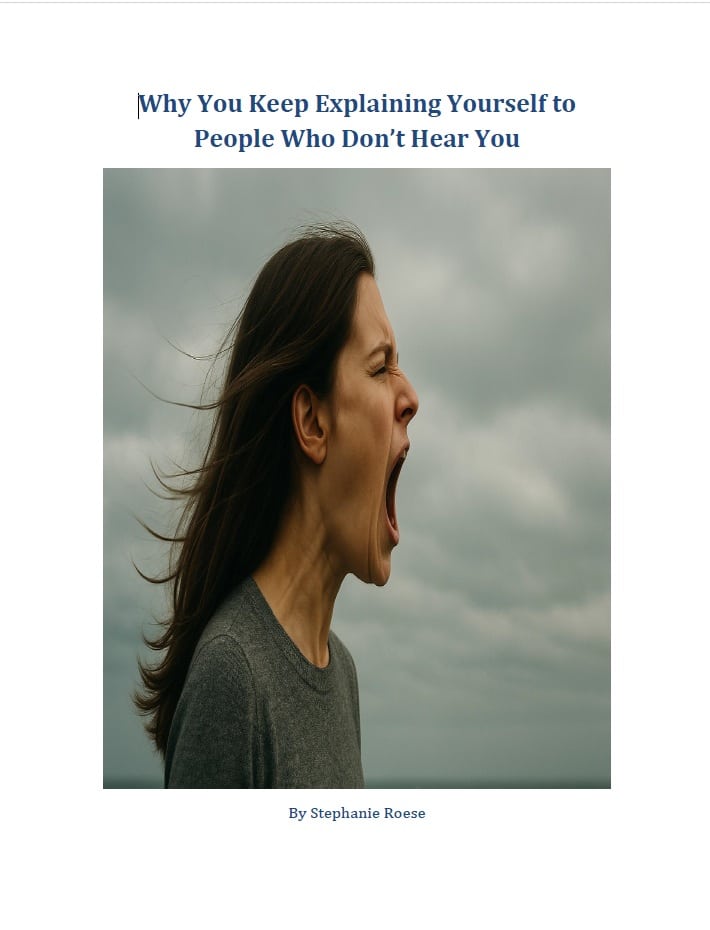
Photo Credit: Unsplash
Guest Post Disclaimer: This guest post is for educational and informational purposes only. Nothing shared here, across CPTSDfoundation.org, any CPTSD Foundation website, our associated communities, or our Social Media accounts, is intended to substitute for or supersede the professional advice and direction of your medical or mental health providers. The thoughts and opinions expressed are those of the guest author and do not necessarily reflect the views of the CPTSD Foundation. For further details, please review the following: Terms of Service, Privacy Policy and Full Disclaimer
- About the Author
- Latest Posts

BIO: Stephanie Roese is a trauma‑informed author and digital creator of free healing tools and resources that offer clarity, validation, and support for anyone rebuilding from the effects of a toxic relationship. Explore more of her work at https://unseenscars.vip and https://blog.unseenscars.vip.
She also wrote the highly rated Unseen Scars Workbook: A Self‑Help Guide to Heal from Emotional Neglect, Gaslighting and Narcissistic Abuse.
Thank you for raising awareness. It will help readers overcome a toxic mentality. Choosing ourselves over and over again is not a sin. We should learn to love ourselves first before sharing love with others.
Thank you, Peter. I really appreciate your comment. It took me a long time to figure that out, and I’d love to help shave decades off that journey for others still finding their way there. Hugs to you!