

“What’s wrong with you?” she asks the person in the mirror. This echo reverberates within her head as a chorus of voices. Her mother’s voice mingles with her own, changing in tone and pitch throughout her four decades of life, yet always asking the same question. Though she never finds an answer that seems to stick, she finds many faults masquerading as possibilities.
She hears the voice of the five-year-old shamed for being overly rambunctious, the 12-year-old who struggles to make friends, the 16-year-old who actively fantasizes about death, the 22-year-old who has no idea what to “do with her life,” the 30-year-old who is too depressed to get out of bed, the 35-year-old mother who can’t seem to find joy in every moment of motherhood, the 41-year-old who erupts into tears during a dental procedure, and on and on. They all chime in.
This person in the mirror itemizes every mistake that she has made throughout her life. She criticizes her inability to form and maintain deep relationships. She nitpicks her physical “shortcomings” and catalogs all the ways she is simultaneously “too much” and “not enough.” Unable to answer the question, she carries these shackles of self-deprecation as “proof” of all that is “wrong” with her.
A part of me, however, stands beside her and sees a survivor. I see that there is nothing wrong with her, but rather the situations she faced. I see a five-year-old child who was just being a kid, her noise and frenetic energy not compatible with my young mother’s exhausted and overwhelmed nervous system. I see a 12-year-old entering my third school in as many years, not seeing a point in making new friends. Besides, I was pretty sure my “peers” couldn’t relate to a parent almost intentionally killing them during the first week of school. I see a 16-year-old hunted by a predator in my own home.
As if that wasn’t enough, that year I felt survivor’s guilt for being able to walk while my then-boyfriend lay hospitalized after becoming paralyzed in a car accident months earlier. I see a 22-year-old who, against all odds, graduated from college but didn’t feel “worthy” of a “real job” or healthy relationships. How could I possibly have known what to do, how to be, in those “normal” contexts?
I tried to be “normal,” but couldn’t define it, and only now do I understand that it is because “normal” doesn’t exist.
I didn’t understand it then, though…I only saw someone who felt “wrong.” It would be another decade before I saw beyond the flaws. Within that old lens, I see a 30-year-old who still didn’t know “what to do with my life.” My shame around this only grew under the unforgiving lens of my mother’s criticism, which she unloaded all at once in an argument. Under the influence of a substantial amount of alcohol, she held nothing back in her assessment of all the ways I’d failed.
Apparently, I have crappy taste in men, and my recent attempt to prove my worth by earning another degree had backfired. Mom berated me for supposedly thinking I’m “smarter than everyone.” I didn’t think that, but her words momentarily stole my will to participate in life, which, according to her, I was failing anyway.
A half-decade later, I see an overwhelmed 35-year-old mother of a one-year-old. They say it takes a village to raise a child; unfortunately, that didn’t apply to me in my mid-thirties because help didn’t exist in places where one might expect it, and I simply didn’t know how to ask for it. That word wasn’t in my vocabulary. Little did I know, I would have one more child, and I was only in the dawn of the exhaustion that is now second-nature. It would be another seven years before I had my first and only 48-hour break from motherhood.
The overwhelm and fatigue, along with an overpowering love for my children, is what finally encouraged me to make some changes in my early 40s. Those changes came with some stark realizations and interesting experiences, like having a breakdown in a dental chair at 41 years old when I couldn’t hold my crap together for another second. As my startled dentist tried to soothe his suddenly sobbing middle-aged patient, I asked myself the same question I always ask myself: “What is wrong with you?” (Sometimes I use other words like “Why am I like this?” and “Would the world be better off without me in it?”)
The problem is, all this time, no matter how I phrased it, I’ve been asking myself the wrong question. There’s nothing “wrong” with me. There’s plenty wrong with the circumstances I’ve faced. The real question should have been, “What is happening to and around you to make you feel this way?”
That question, however, was not written into the original script. Five-year-olds who grow up in healthy, supportive environments don’t ask themselves, “What’s wrong with me?” Ironically, those words often first come from the person or people responsible for providing a supportive and secure environment for that child. Having failed to do that and instead of taking responsibility for their shortcomings, these people sometimes direct the blame to the child.
Over time, their voice(s) mingle with ours, and the question that should have never been asked imprisons us in insecurity. We find ways to justify the question. We stockpile our “failures” and can give you a grand tour of places we went wrong. It’s easy to showcase our faults.
What happens if we turn that logic outward? Think about someone you love. Imagine them internalizing the message that something is wrong with them. How do you feel? This piece, inspired by someone dear to me, was born in my anger at her being held prisoner by the very words that are as present in my head as stars in a night sky. Her self-defacing mantra was also planted by a parent and then reinforced by her own inner voices for decades. I look at her and see bravery, humility, and strength. I don’t see anything “wrong” with her. Instead, my focus narrowed to a person I’ve never met. A part of me fought the urge to deliver an unsolicited, unfiltered piece of my mind to her mother.
How dare she say something so awful to this person who brings so much light to the world? I wrestled with how I could remove the sting of these words from my friend’s heart. How could I possibly convince her that there is nothing wrong with her? How could she believe something so ridiculous about herself?
And then…I silently acknowledged that I’d swallowed the same poison. It was not until I heard those words within the context of a loved one’s internal narrative that I so blatantly questioned them in myself. I, too, had been asked that question by my mother. I, too, believed that since she asked the question (repeatedly), there must surely be something “wrong” with me. I have spent much of my life searching for the answer to that question. I’ve identified a slew of potential candidates, but nothing has felt solidly “right.”
Well…at 43 years old, I finally found the answer to the question “What is wrong with you?” Ready for it? It’s a real nail-biter.
Here it is: not a damn thing. Do I have flaws? Areas for improvement? Weaknesses? Yes, of course. We all do. But there’s nothing “wrong” with me. It is “wrong” that my mother ever demanded an answer to such a ridiculous question. It would be easy to get angry at her the way I did at my friend’s mother. In thinking about it, however, I suspect that they, too, have stood in front of mirrors and asked: “What’s wrong with you?”
Likely, long ago, someone carelessly hurled that very question at them. I think asking that question of another person is a sign of something unbalanced or emotional malnourishment within. I feel compassion for anyone who has asked this question of another, for I know it is born in insecurity.
That’s not to say that I’m not mad. This ridiculous question made my blood boil when my friend acknowledged it as an internal mantra. When I internally admitted that I shared this mantra, I decided I’m not buying it anymore. The fact that these words live within me only renews my commitment to healing. I will not ask this question of my children, and I will do my very best to ensure that their environment does not create inner chaos.
Furthermore, though this question can sweep in at the drop of a hat for me, I will be conscious of its roots. I will rephrase the question. Instead of demanding to know what is wrong with me, I will ask myself what was wrong with the circumstances that created these feelings.
So many of us have been asked this question that shouldn’t be asked. Even worse, it has often been asked by the people we looked to for love. Instead of searching for answers we will never find, let’s reframe the question and consider who asked it and why. When we consider the source and motivation for this question and reword it to explore what was wrong with what we faced, we infuse it with what was missing all along: compassion. There was never anything wrong with us.
We simply did our best to handle things we shouldn’t have had to experience. It’s time to stop trying to answer the question that should not have been asked. So, if you, too, have been asked this ridiculous question, please remind yourself that you finally found the answer: not a damn thing.
Guest Post Disclaimer: Any and all information shared in this guest blog post is intended for educational and informational purposes only. Nothing in this blog post, nor any content on CPTSDfoundation.org, is a supplement for or supersedes the relationship and direction of your medical or mental health providers. Thoughts, ideas, or opinions expressed by the writer of this guest blog post do not necessarily reflect those of CPTSD Foundation. For more information, see our Privacy Policy and Full Disclaimer.


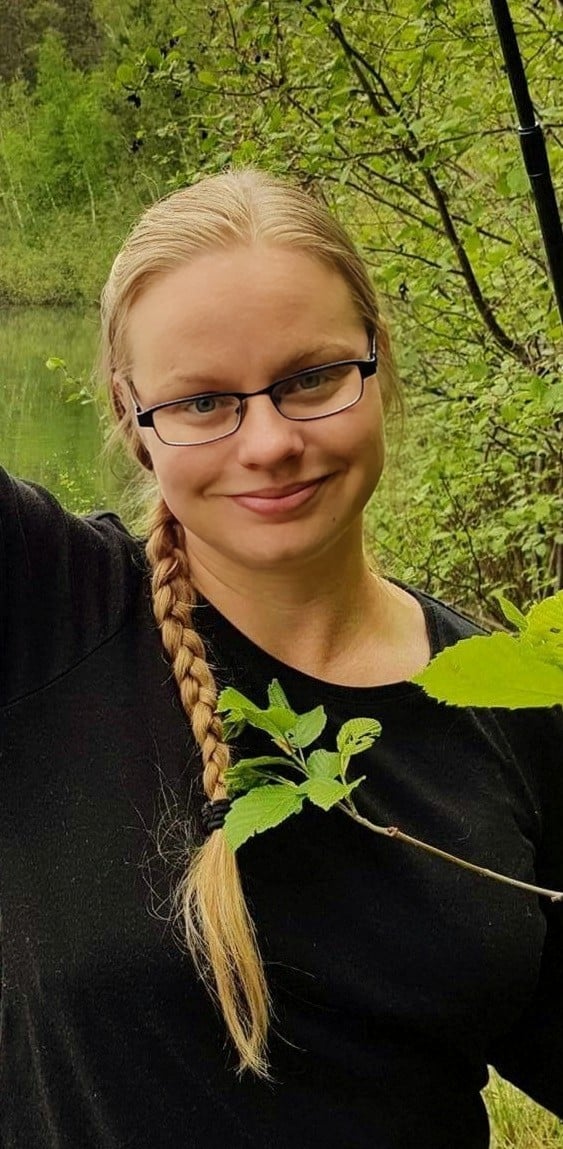
Finally feeling truly alive for the first time in my life, I am writing from a place of gradual healing with an eye to the future and a hope of connecting with others on similar paths. Forced to withhold a tsunami of emotions deemed irrelevant under the roof of my childhood “home,” the blank white pages of my notebooks invited my raw reflections without judgment. Writing allowed me to free the burdens of my soul, but at some point, I muzzled myself. My pen lay dormant for years until, at 41 years old, I experienced a traumatic flashback during an everyday activity that shook me to the core. Five days later, I started writing about the things I had long withheld. I couldn’t stop. Written words have once again become my refuge. I now recognize that these words, resurrected from the ashes of my pain, may have the power to help others. Above all, I want to magnify and share the messages that I have most treasured on my journey: we are not alone and we don’t ever have to go back. This is where we live now and the future is ours.
Yes, there is nothing wrong with us. What is wrong is what has caused us to reflect that question to ourselves. The situations that put us there is wrong. It is good that you worked and rephrased it to be, I will ask myself “what was wrong with the circumstances that created these feelings.”