
LOVE: They Say They Love Me, But Keep Hurting Me. Can Love and Harm Coexist?

Do they love you? Do you love them? How to tell the difference between love and something else. Let’s break down why we stay when authentic love is scarce and where to start healing.
What Is Love? (Baby Don’t Hurt Me)
The stories that follow represent experiences many survivors face when navigating relationships affected by trauma. Lucille and Dominique’s journeys aren’t outliers or extremes – they illustrate common patterns that emerge when love becomes entangled with harm. Through their experiences, we can explore the confusion, pain, and ultimately the clarity that comes from understanding love’s true nature amid the fog of trauma.
As you read through these stories and concepts, you may find yourself confronting painful questions: “How did I not see this sooner?” “Am I stupid for loving someone who treats me this way?” “Why do I keep making the same relationship mistakes?” Please know that these thoughts are not only common but an expected part of processing relationship trauma. Later in this article, we’ll explore why intelligent, perceptive people find themselves caught in these patterns and why self-blame isn’t just undeserved—it’s actually part of the trauma itself. If these thoughts arise as you read, try to notice them with gentleness, knowing we’ll address them directly when we explore the grief that comes with recognizing what’s been missing in our relationships.
Lucille’s Choice
Lucille sat on the floor of her new apartment, surrounded by half-unpacked boxes that contained the modest remains of her former life. The afternoon sun cast long shadows across bare walls – walls that held no family photographs, no inherited heirlooms, no visual reminders of where she had come from.
Three months ago, she had made the hardest decision of her life: to move across the country and change her phone number, cutting contact with her family of origin. It wasn’t done in anger or as punishment. It was done because she finally understood that her survival depended on it.
For years, Lucille had battled thoughts of ending her life. Each interaction with her family – the subtle criticisms, the dismissal of her feelings, the explosive arguments followed by pretending nothing had happened – left her feeling hollowed out, worthless, and increasingly convinced that her presence in the world was unnecessary. Therapy had helped her recognize that these weren’t her original dark thoughts but internalized messages planted through years of emotional abuse.
“You just need to be stronger,” her mother would say whenever Lucille tried to discuss her depression. “Everyone has problems. I love you, but you’ve always been too sensitive.”
Before he died, her father’s approach had also been damaging. Though he too regularly told Lucille he loved her, his actions communicated something else entirely. He would walk away whenever emotions entered the conversation, dismiss her accomplishments, and make all her life choices about himself, criticizing anything she did that he felt made him look bad. The stark contrast between his words of love and his acts of rejection created a confusing double-bind that Lucille had spent decades trying to reconcile.
When her father had been diagnosed with terminal cancer, Lucille dropped everything to care for him. She spent months shuttling between hospitals and his home, managing his medications, coordinating with doctors, and sitting beside his bed during long, silent nights. Her siblings visited occasionally, but the daily burden fell to Lucille.
What confused Lucille most was her own reaction to his diagnosis. Despite years of emotional neglect and having essentially given up on ever having a real relationship with him, when she learned about his cancer, she was overcome with panic and terror. She sobbed uncontrollably at the thought of losing him. This panicked devotion felt entirely disconnected from her understanding of their relationship.
Despite his lifelong emotional unavailability, she couldn’t bear the thought of him suffering. Throughout those months, she kept spending her own limited money on things to make his room nicer. She wanted the whole family to come closer and lend emotional support during this hard time. She waited for a shift in what “I love you” felt like. It never came. Her father died as he had lived – emotionally closed. And her family never hugged and cried together, she felt utterly out of place.
Oddly, once he passed, Lucille didn’t really miss her dad. The grief she expected never materialized. This confused her deeply – how could she have felt such desperate attachment at the thought of losing him, yet such numbness once he was gone?
Sometimes, when Lucille questioned whether her parents had ever truly loved her, a particular memory surfaced—one that made it harder to walk away. She was nine, home sick with the flu, curled up on the couch in a ball of fever and chills. Her mother, who usually brushed off illness as weakness, had unexpectedly brought her a bowl of homemade soup and stroked her hair while Lucille drifted in and out of sleep. For that one afternoon, there was no criticism, no tension—just warmth. Lucille had clung to that sliver of tenderness for decades, using it as proof that love had existed, even if it had rarely returned.
After her father’s death, Lucille hoped that perhaps her mother would finally become more emotionally available. She had always believed that her father’s narcissism somehow prevented her mother from showing the warmth and empathy Lucille craved. With him gone, Lucille waited for the mother-daughter relationship she had always wanted.
Instead, her mother’s emotional neglect continued unchanged. When Lucille finally gathered the courage to express her needs directly, her mother responded with dismissal. This final rejection of what seemed like such a reasonable request – to be treated with basic empathy – felt like a betrayal. The subconscious fantasy that had sustained Lucille for years – that her mother was capable of loving her but simply prevented from doing so – collapsed entirely.
Lucille had tried casual distancing with her remaining family. She had tried limited contact. She had tried explaining how their behaviors affected her. They would respond by insisting they loved her, but nothing changed, except that her resolve to stay alive grew more tenuous with each attempt at connection.
So she left. Not with a dramatic announcement, but quietly, as if stepping backward out of a room where no one had noticed her presence anyway.
Now, as she unpacked her sparse belongings in this new space, Lucille realized something unexpected. The crushing weight she had carried for so long had begun to lift. She slept through the night. The constant knot in her stomach had eased. Most surprising of all, she didn’t miss them. She had anticipated grief, guilt, longing – but what she felt instead was relief. Freedom. Space to breathe.
And this confused her deeply. If she loved her family – and surely she must love them, they were her family after all – shouldn’t she miss them? Shouldn’t their absence feel like a wound rather than a healing? If she could feel this peaceful away from them, had she ever truly loved them at all? Or was the fierce protectiveness she had always felt toward them, the desperate hope that they would change, the willingness to endure their mistreatment just to remain connected – was that something else entirely?
As she reflected, Lucille realized she had already been grieving her family for decades – grieving the relationships she had always wanted but never had, grieving the support and love that never materialized. The grief had started long before she physically left.
Even now, in her moments of peace, bitter memories would occasionally ambush her – her brother mocking her teenage poetry, her father saying “I love you, princess” while turning away when she tried to hug him, her mother ignoring her tears. Each memory triggered physical symptoms – racing heart, tight chest, the urge to hide. Her therapist had explained these as symptoms of complex trauma, remnants of a nervous system still responding to dangers no longer present.
Her mother had reached out through mutual connections, expressing profound hurt at Lucille’s decision to cut contact. “Why did you leave me? I miss you. I’ve always loved you more than anything,” she had said, words that triggered waves of guilt and confusion in Lucille. Was she wrong to protect herself? Was her mother’s pain more important than her own survival?
It had been three weeks since any fleeting thoughts of not wanting to be alive had drifted through her mind, a vast improvement. As Lucille placed a small plant on her windowsill – the first living thing she had ever felt confident she could nurture – she wondered: What exactly is love, anyway? And can we love someone we cannot safely remain connected to?
Dominique’s Boundary
Dominique stood in the center of what was now her room, a small utility room she had transformed into a sanctuary. The walls were freshly painted in soft blue, a color her husband disliked. Books she loved filled the bookshelf. A comfortable single bed replaced the air mattress she’d been sleeping on for the past two weeks.
Ten years into her marriage, Dominique had discovered her husband’s secret porn habit. While devastated, she had committed to working through it together. He had promised to stop, and as far as she could tell, he had kept that promise. But three years later, she discovered something worse – while there had been no physical affair, her husband had maintained inappropriate emotional relationships with several women, flirting, sharing private marital struggles, and seeking validation outside their marriage. When confronted, he dismissed her concerns, insisting she was trying to control him and “overreacting.”
This pattern of dismissal was nothing new. Throughout their marriage, Dominique had consistently found herself at the bottom of her husband’s priority list. He never missed his weekly basketball game with friends, but frequently forgot commitments he’d made to her. He remembered his mother’s favorite flowers but couldn’t recall Dominique’s birthday without a reminder. He would stay late at work to help a coworker but rarely offered the same support to her. In the early years, before the erosion began, he used to write her notes and make her laugh until she cried. That version of him felt like a dream she had once believed with all her heart.
What made all of this especially painful was that Dominique had chosen to save herself for marriage. Her decision to wait for physical intimacy had been deeply important to her. Yet within the first week after their wedding, her husband began turning down her advances. This profound rejection, followed by his years of sexual disinterest while maintaining a secret porn habit, left her questioning her identity as a woman and feeling fundamentally undesirable.
For years, Dominique had silenced the alarm bells in her body – the tightness in her chest when he was nicer to the female server than he ever was to her, the nausea when he dismissed her feelings, the exhaustion from constantly wondering when the next wrecking ball would hit. She had convinced herself that marriage required sacrifice, that her discomfort was the price of keeping her family intact. Somewhere along the way, she had mistaken endurance for virtue.
Periodically, only after Dominique took action to distance herself, her husband would seem to recognize the damage his behavior caused. He would apologize, promise to change, and show genuine improvement for weeks or even months. During these periods, he would be attentive, communicative, and seemingly committed to rebuilding their connection. Each time, Dominique would cautiously hope that this change would last. And each time, once she had emotionally reinvested in the relationship, he would gradually return to his old patterns, as if maintaining healthy connection required too much effort to sustain.
With two young children and no independent income, leaving seemed impossible. After a particularly painful argument – where her husband had once again shown complete disregard for her emotional safety – something in Dominique shifted. She didn’t have the resources to leave the house, but she could leave the bedroom. She could create a boundary, a space where she didn’t have to pretend.
On her first night in the new bedroom, Dominique had expected to feel sad, to mourn the loss of the marriage she had wanted. Instead, she felt an unexpected lightness, almost giddiness. The relief of not having to sleep next to someone unsafe, of not having to wake up with a feeling of dread seeing him there – it was overwhelming. For the first time in years, she felt free.
In the weeks that followed, Dominique and her husband established a careful choreography of co-parenting. They shared meals with the children, coordinated schedules, maintained the appearance of family unity. But beyond these necessary interactions, they rarely spoke. Her husband, who was taking her warnings seriously for the first time, occasionally attempted to discuss “fixing” their marriage, insisting he loved her and wanted to make things work. Dominique would simply respond, “What you did wasn’t love. If you loved me, you wouldn’t have lied to me for our entire relationship.”
Since their in-home separation, her husband had begun therapy, stopped his emotionally unfaithful behaviors, and was working on healthier communication styles. He seemed genuinely committed to change, though still very limited in his understanding. Yet despite these improvements, Dominique felt no return of warmth toward him. Her nervous system remained on high alert in his presence; her body remembered the years of emotional abandonment even as her mind acknowledged his efforts.
The strangest part for Dominique was that even with these changes, even wondering if she could eventually have financial independence if she returned to work once the children were older, she couldn’t imagine actually divorcing him. The thought of being the only two people left in the house after the children eventually moved out felt like a crisis, yet she couldn’t picture taking the final step to legal separation. This confused and frustrated her – why couldn’t she leave, even in her imagination? What invisible force held her in this relationship when all warmth and connection had died?
Sometimes Dominique worried that she had lost the capacity for romantic love entirely. The thought of physical intimacy – with her husband or anyone else – left her cold. Was this a temporary protective shutdown, or a permanent change? Had the years of emotional neglect and betrayal fundamentally altered her ability to connect?
Like Lucille, Dominique realized she had already been grieving her marriage long before learning about her husband’s secrets – grieving the partner she had thought she married, grieving the future she had imagined, grieving how she’d been mistreated, grieving the person she had been before repeated betrayals had taught her to expect pain from closeness and made her put up walls.
And like Lucille, she experienced unexpected moments of bitterness – rage at the years she had wasted trying to earn love from someone refusing to give it, sorrow for the younger self who had accepted so little while giving so much. These emotions would arrive without warning, bringing with them physical symptoms – headaches, digestive issues, overwhelming fatigue, panic attacks – that her therapist identified as manifestations of trauma stored in her body.
As she arranged her new space, placing framed photos of her children and herself (but none of her husband) on the dresser, Dominique wondered: Was what she and her husband had over the years ever love? And if not, what was it? And what would happen to this family once the children were grown?
What Is Love?
Love is perhaps the most discussed yet least understood human experience. We speak of it as an emotion, a choice, an action, a bond, and a commitment – sometimes all at once. To build a meaningful understanding of love, particularly when examining it through the lens of trauma and healing, we need to consider both its behavioral expressions and its felt experience.
At its core, love is a combination of genuine care for another’s wellbeing coupled with consistent actions that demonstrate that care. However, how this care is expressed may vary significantly based on neurological differences.
True love manifests through:
- Consistent kindness and compassion toward the other person
- Deep respect for their autonomy, thoughts, and feelings
- Active support during both their triumphs and struggles
- Understanding that accepts imperfection without enabling harm
- Reliability that builds trust and safety
Bell Hooks in her book All About Love eloquently defined love as “a willingness to extend ourselves for the spiritual growth of others.” While profound, this definition may seem abstract to those seeking practical understanding. We might expand this to say that love is the ongoing commitment to support another’s fullest, healthiest self-expression and development, while respecting their autonomy and honoring our own boundaries and wellbeing.
Neurodivergent Expressions of Love: Different, Not Deficient
When discussing authentic love, it’s crucial to recognize that neurodivergent individuals (those with autism, ADHD, sensory processing differences, etc.) may express love in ways that don’t align with neurotypical expectations. These differences don’t indicate an absence of love or attachment, but rather reflect fundamental neurological variations in how connection is experienced and expressed.
How Neurodivergent Love May Look Different
Communication Styles: An autistic partner might express love through detailed information-sharing about special interests rather than conventional romantic gestures. They may demonstrate deep care by solving practical problems or creating systems that support your wellbeing, rather than through words of affirmation or physical touch.
Emotional Processing: Neurodivergent individuals may process emotions differently—sometimes experiencing them more intensely, less intensely, or with delayed recognition. A partner with alexithymia (difficulty identifying emotions) might deeply love you while struggling to articulate those feelings in ways you immediately recognize.
Sensory Considerations: For those with sensory sensitivities, traditional expressions of love like sustained eye contact, certain types of physical touch, or crowded social gatherings might be genuinely distressing—even when desire for connection is strong. Their avoidance isn’t rejection but self-regulation.
Executive Function Impact: Someone with ADHD might forget anniversaries or struggle with consistent check-ins not from lack of care, but from differences in time perception and executive functioning. Their love might appear in bursts of hyperfocus and enthusiastic connection rather than steady, predictable patterns.
Distinguishing Difference from Harm
The key distinction: neurodivergent expressions of love may look different, but they should never be consistently harmful. Mutual respect, basic consideration, and willingness to understand each other remain essential regardless of neurotype.
When a neurodivergent person loves you, they may:
- Need explicit communication about your needs rather than picking up subtle cues
- Show care through unconventional but meaningful gestures
- Require accommodations for sensory or executive functioning differences
- Express love more directly or literally than you expect
However, neurodivergence never excuses:
- Consistent emotional neglect or dismissal of your feelings
- Refusal to acknowledge impact regardless of intent
- Unwillingness to work together on mutually satisfying compromises
- Using diagnosis as a shield against accountability
Building Bridges of Understanding
For neurotypical-neurodivergent relationships to thrive, both partners need:
- Explicit communication about needs and expressions of care
- Willingness to translate across neurological differences
- Recognition that different doesn’t mean deficient
- Respect for neurodivergent boundaries and accommodations
For readers questioning whether differences in love expression reflect neurodivergence or genuine emotional unavailability, consider: Does this person demonstrate consistent care in their own way, even if it’s not your preferred style? Are they willing to discuss these differences with openness rather than defensiveness? Do they acknowledge impact even when intent was different? The answers help distinguish between neurological differences and truly harmful patterns.
Love, in its healthiest form, is never one of submission, self-erasure, or suffering. True love cannot coexist with patterns of abuse, control, or disrespect. This fundamental truth forms the foundation for the questions we’ll explore throughout this article.
Understanding the Person Who Cannot Love: It’s Not About You
The Gap Between Knowing and Feeling
While intellectually understanding “it’s not about me” can provide relief, your body may still react as if you’re the problem—flooded with shame, self-doubt, or the urge to become “enough” to earn love. This disconnect between mind and body is normal when healing from relational trauma.
As you read, notice if your body tenses, if thoughts like “but in my case, it really was my fault” arise, or if you feel compelled to defend the person who hurt you. These responses don’t mean the information is wrong—they signal your nervous system is processing truths that challenge deep survival beliefs. Healing begins when we hold both the intellectual truth and the body’s protective reactions with compassion.
Why Some People Cannot Love Authentically
Most people are born with the capacity for love, seeking connection instinctively. Under healthy conditions, secure attachment forms through consistent, attuned caregiving, creating a blueprint for future relationships.
Yet this innate capacity can be profoundly disrupted by:
- Childhood Attachment Wounds
When early needs for safety, attunement, or validation go unmet, the ability to form secure bonds fractures. A person who never received consistent love struggles to give what they’ve never known. Their relational template organizes around survival rather than mutual care. - Survival Adaptations
Harmful behaviors often begin as creative childhood strategies. Emotional withdrawal, control, or manipulation may have once shielded them from overwhelm or danger. These adaptations become automatic, operating far below consciousness. - Intergenerational Trauma
Patterns of neglect, abuse, or dysfunction often pass through generations like an invisible inheritance. Epigenetic research and attachment studies show how relational behaviors and stress responses are unconsciously replicated, even when they cause harm. - Developmental Trauma
Trauma during critical developmental stages can alter brain structures governing empathy, emotional regulation, and connection. This may impair their ability to read emotions, regulate stress, or maintain consistent presence. - Personality Structure
Some develop psychological frameworks (e.g., narcissistic or borderline patterns) organized around protecting a fragile sense of self. Their entire system avoids vulnerability—the cornerstone of authentic love. While these patterns are deeply entrenched, some individuals, particularly those who commit to long-term therapy, can develop a limited capacity for reciprocity over time. Their limitations don’t reflect a conscious choice but a psychological system that makes genuine connection feel threatening.
In rare cases, genetic predispositions combined with severe early trauma may result in an almost absent capacity for empathy or attachment, as seen in some antisocial traits. These extremes highlight that love’s absence isn’t always about you—or even something the other person can fully control.
The Nuance of “Self-Love First”
The adage “you can’t love others until you love yourself” contains partial truth but oversimplifies. While self-worth fosters healthier relationships, love isn’t just a choice or self-improvement project. It emerges from biology, early experiences, culture, and relational history.
The person who cannot love you authentically isn’t merely “choosing not to love themselves.” They may be trapped in attachment wounds, nervous system dysregulation, or personality structures that render vulnerability intolerable. That said, rebuilding your own self-worth remains essential—not to change the other person, but to break cycles of tolerating inadequate love.
What This Understanding Offers You
- Freedom from the Impossible Task
Recognizing their limitations stem from factors beyond their (or your) control liberates you from the fantasy that “if I just try harder, they’ll change.” You’re released from a mission that was never yours. - Compassion Without Compromise
Understanding their wounds allows compassion—without confusing it with permission. You can think, “This person acts from unhealed trauma,” while affirming, “I deserve relationships that don’t demand my self-abandonment.” Healthy boundaries aren’t punishment; they prevent further harm to both parties. - Breaking Trauma Bonds
Intermittent reinforcement—cycles of idealization and devaluation—can create addictive emotional hooks. Understanding the other person’s limitations can help you recognize that the “good times” aren’t evidence of potential for consistent love, but rather part of a pattern driven by the person’s own attachment needs. Seeing these patterns helps you disrupt their pull and choose relationships grounded in consistency, not familiarity with pain.
The Line Between Understanding and Enabling
A trauma history explains behavior but never excuses it. Compassion for someone’s wounds doesn’t require tolerating harm. In fact, boundaries with those incapable of authentic love may be the most compassionate act—for yourself and them.
Their inability to love reflects their limitations, not your worth. You can grieve the wounded child they were while refusing to be harmed by the adult they’ve become.
Remember: Their deficits were never about you. Your worthiness of love is immutable, regardless of another’s capacity to recognize it.
When Attachment Isn’t Love: Understanding Trauma Bonds
The Biology of Trauma Bonds and Fantasy Attachments
One of the most confusing aspects of recovering from relationship trauma is reconciling the intense feelings we have for those who have harmed us. Many survivors describe feeling desperately attached to those who hurt them – experiencing anxiety when separated, relief when reunited, and persistent hope that things will improve despite evidence to the contrary.
Trauma bonding occurs when a powerful emotional attachment forms through repeated cycles of abuse, tension, and reward. This happens on a biological level – when an abuser unpredictably alternates between cruelty and kindness, it triggers the brain’s survival mechanisms and addiction pathways. The resulting biochemical response creates feelings that can be more intense than typical romantic or familial love.
This biological reaction involves several key processes:
- Stress hormones and pleasure chemicals create powerful emotional highs and lows
- The body’s natural pain/pleasure system becomes dysregulated, creating addiction-like patterns
- The primitive attachment system, designed to keep us connected to essential caregivers for survival, overrides our logical assessment of danger
For someone like Dominique, her husband’s occasional moments of attentiveness after long periods of neglect created exactly this kind of emotional rollercoaster. Each improvement triggered hope, flooding her system with relief and reinforcing her attachment despite the overall pattern of emotional abandonment.
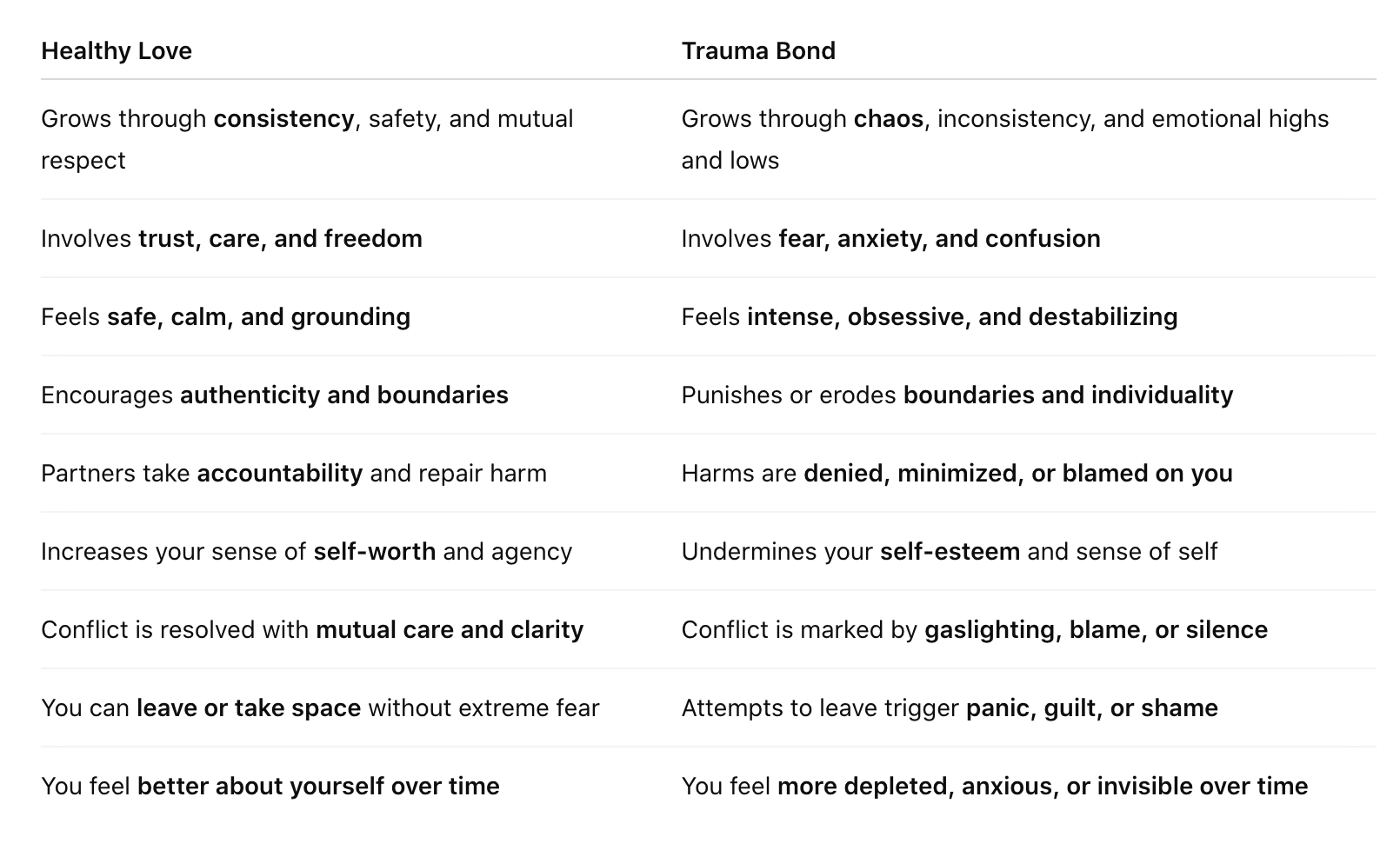
Many survivors describe their trauma bonds as the most powerful “love” they’ve ever felt. These feelings are real and overwhelming, but there’s a critical distinction: trauma bonds are rooted in survival responses, not authentic love. They revolve around relieving anxiety and pain rather than mutual growth and joy. They create dependency rather than healthy connection. And they feature dramatic highs and devastating lows rather than consistent safety and respect.
Often what keeps someone in a harmful relationship isn’t love for the person as they actually are, but attachment to who they could potentially become. This “fantasy bond” involves loving a fictional future version of the person rather than accepting the reality before us.
Dominique wasn’t in love with her husband as he was – chronically dishonest and emotionally withholding. She was in love with who he had pretended to be (who she believed was the “real” him) in the beginning, and who he could be again if he overcame these tendencies and went back to his “real” self. Each small improvement reinforced this fantasy, keeping her invested in a future that never fully arrived.
Lucille experienced a similar pattern with her mother. After her father’s death, she clung to the fantasy that her mother would finally become emotionally available. When this didn’t happen, Lucille felt not just disappointed but betrayed – as if a promise had been broken, though no such promise had ever been made except in her own mind.
When survivors finally accept that this potential version of their loved one may never exist, they experience grief – not just for the relationship, but for the death of a dream they’ve held onto, sometimes for decades.
Love vs. Trauma Bond: How to Tell the Difference
The Existential Search for Love’s Logic
Beyond the biological mechanisms of trauma bonding lies an even deeper existential drive. When someone who should love us fails to do so consistently, we often find ourselves returning to check if love has finally appeared—not just from emotional need, but from a profound desire to make the world make sense.
This impulse operates below conscious thought, arising from our instinctive understanding that being properly loved is the natural order of things. The mind struggles to accept a reality where this fundamental need remains unmet by those designed to fulfill it.
It’s like desperately craving a hug from the person who just punched you—a paradoxical yearning that defies logic but speaks to our soul’s deep need for coherence. This creates a reflexive pattern where, even after painful interactions that logically should push us away, survivors experience an overwhelming urge to reconnect—as if drawn by gravity to repair the tear in the fabric of how relationships should work.
This isn’t merely attachment seeking security; it’s the human spirit seeking coherence in a situation that fundamentally violates our deepest understanding of how the world should function.
The Protective Shutdown: When Your Body Says “Enough”
Both Lucille and Dominique experienced moments of emotional detachment – periods when they felt numb or even disgusted toward people they had once deeply cared about. This numbing isn’t a character flaw or evidence of coldness; it’s a protective mechanism deployed by an overwhelmed nervous system.
Emotional numbness is your body’s way of protecting you from repeated emotional injury. When you’ve been hurt too many times in a relationship, your nervous system essentially “powers down” emotional receptivity to prevent further damage. This protective shutdown often involves the dorsal vagal response – a primitive survival strategy that conserves resources when fighting or fleeing isn’t possible.
Signs of this protective shutdown may include:
- Feeling emotionally “flat” or numb
- Physical distance (avoiding touch or proximity)
- Cognitive distance (difficulty remembering positive aspects of the relationship)
- Dissociation (feeling detached from your own emotions or body)
- Disgust or aversion toward the person who caused harm
For Dominique, her aversion to physical intimacy represented this kind of protective mechanism; her body wisely refused to remain vulnerable with someone who had repeatedly proven unsafe with her heart.
Rather than seeing this as “falling out of love,” we might understand it as the protective wisdom of a body and heart that value survival over harmful attachment. This emotional detachment represents the natural boundary that love requires to sustain itself. Just as our physical pain response prevents us from keeping our hand on a hot stove, emotional detachment prevents us from continuing to invest in connections that consistently cause harm.
For some survivors like Lucille, suicidal thoughts can emerge as the ultimate form of protective shutdown. In therapeutic approaches like Internal Family Systems (IFS), these thoughts are understood not as self-destructive impulses but as desperate attempts by protective parts of the self to end unbearable emotional pain when no other escape seems possible. These parts believe they’re helping—trying to protect the person from continued suffering when all other coping mechanisms have been overwhelmed. Recognizing these thoughts as misguided protection rather than character flaws can reduce shame and create space for healing. When Lucille’s suicidal ideation decreased after establishing physical distance from her family, it demonstrated how creating external safety can reduce the need for these extreme internal protective measures.
When Your Mind and Body Are on Different Timelines
For many survivors like Dominique, a confusing disconnect emerges between intellectual understanding and bodily response. Her mind had already cataloged her husband’s betrayals and recognized the relationship as harmful—yet something kept her physically unable to take decisive action toward divorce.
This mind-body gap creates profound confusion. “If I know this relationship is damaging me, why can’t I just leave?” survivors often wonder. “Am I weak? Do I secretly want to stay? Is something wrong with me?”
This mismatch isn’t weakness or contradiction—it’s your nervous system working exactly as designed. Your cognitive brain can process information and reach conclusions rapidly through conscious thought. Your body, however, changes more gradually, through lived experience rather than intellectual insight.
Dominique’s conscious mind understood her marriage was unhealthy, but her nervous system—shaped by years of intermittent reinforcement and trauma bonding—remained physiologically tethered to the relationship. Her body remembered both the pain and the occasional relief of connection, creating a complex web of neurological and hormonal responses that couldn’t be dismantled through reasoning alone.
This gap explains why many survivors experience the frustrating cycle of “knowing better” while feeling unable to act on that knowledge. You might intellectually recognize a relationship as harmful on Monday, yet find yourself deeply longing for that same person on Tuesday—not because your assessment was wrong, but because your body is processing change at its own necessary pace.
Healing this disconnect requires patience with your body’s timeline. Rather than forcing action before your nervous system is ready (which often leads to return cycles), focus on gradually building safety signals that allow your body to catch up with your mind. Small, consistent steps toward safety—like Dominique creating her separate bedroom—often prove more sustainable than dramatic gestures that overwhelm your system’s capacity to integrate change.
Harmful vs. Abusive: Understanding the Spectrum of Relational Harm
Relational harm exists on a spectrum – from consciously abusive to unintentionally harmful. While both can damage your wellbeing, understanding where someone falls can help determine whether reconciliation is possible or whether distance is safest. Many survivors struggle to categorize relationships that cause pain but don’t fit clear definitions of abuse. Is Lucille’s mother who failed to protect her from her father’s emotional neglect “abusive,” or simply “harmful”? Is Dominique’s husband who betrayed her trust repeatedly but shows a measure of remorse “abusive” or just deeply flawed? Does intention matter when the impact damages your wellbeing either way?
While impact ultimately matters more than intent, understanding these distinctions can help you navigate complex relationships and determine appropriate boundaries. Consider these differences:
Signs a person may be engaging in abuse:
- Pattern of control and domination (limiting your autonomy, monitoring behavior)
- Consistent disregard for your boundaries after they’ve been clearly communicated
- Calculated manipulation, including intermittent reinforcement to keep you attached
- Emotional punishment when you assert independence or challenge their behavior
- Denies harmful behavior even when presented with clear evidence
- Shows dramatically different behavior in public versus private
- Creates isolation from potential support systems
- Blames you for their harmful actions (“you made me do this”)
- Shows minimal genuine remorse that translates into sustained behavior change
- Uses threats (explicit or implied) to maintain compliance
Signs someone may be harmful without being intentionally abusive:
- Causes harm through passivity or avoidance rather than active control
- Shows genuine remorse and temporary improvement when confronted
- Their harmful patterns often mirror their own unhealed trauma
- Lacks emotional skills rather than deliberately manipulating
- Behavior is more consistent across different relationships and contexts
- May show real confusion or distress when told they’ve caused harm
- Has moments of genuine empathy and connection, though inconsistent
- Harmful behavior often emerges from overwhelm, fear, or limited capacity rather than from desire for control
- May accept boundaries once they truly understand them, though they might struggle to maintain this acceptance under pressure
Questions to help you reflect on your specific situation:
- Does this person show different sides to different people, or are they consistently flawed?
- When they hurt you, do they seem satisfied or distressed by your pain?
- Have they shown capacity for change in other areas of their life?
- Do you generally feel controlled by them, or disappointed by their limitations?
- If they had more awareness and skills, do you believe they would choose to treat you better?
- When they do show improvement, does it seem strategic or genuine?
- Do they seem invested in your growth and independence, even if they struggle to support it?
- When they apologize, is it focused on your pain or their justification?
- Do you find yourself constantly researching their behavior to understand it?
Remember that these distinctions aren’t about excusing harmful behavior, but about helping you understand what you’re dealing with. Even well-intentioned harm can necessitate strong boundaries. The key difference is that relationships with non-abusive but harmful people may have potential for change if the person commits to sustained work with appropriate professional help and sincere effort, while relationships with truly abusive individuals rarely improve sustainably without profound intervention and change.
Your nervous system will often signal the difference before your conscious mind recognizes it. Trust that wisdom—it’s trying to keep you safe. When harm persists despite awareness, even well-intentioned relationships can leave us emotionally numb – a protective response we’ll explore next.
Affirmation: Understanding someone’s harmful behavior doesn’t mean I must endure it. My boundaries protect, not punish.
The Heartbreak of Growing Numb: When You Still Want to Love Someone Who Hurts You
Perhaps one of the most painful experiences for survivors is the disconnect between their hopes and their nervous system’s protective responses. This is especially acute when dealing with people who may not consciously intend harm but repeatedly fail to provide safety—particularly aging parents or long-term partners who seem to understand in some moments yet continue patterns that cause pain.
Many survivors face relationships where the harm isn’t constant or obviously malicious, but occurs in patterns of:
Inconsistent protection – Like a parent who acknowledges your pain in private but won’t stand up for you when it matters, saying they “don’t want to get involved” in conflicts between their children, even when one child clearly harms the other
Moments of genuine connection followed by devastating betrayals – Such as when a parent sincerely validates your experience and promises change, only to revert to harmful patterns when pressured by others
Passive enabling – When someone doesn’t directly hurt you but consistently allows others to do so, perhaps due to their own fears, dependency needs, or conflict avoidance
Selective awareness – When someone seems to genuinely understand in some contexts but becomes conveniently “unable to see” the problem in situations where protecting you would come at personal cost
These unpredictable patterns – where hope and harm alternate – create a special kind of pain because they offer just enough hope to keep you invested while repeatedly demonstrating that the person cannot or will not provide consistent safety. Your nervous system registers this inconsistency not as “sometimes safe” but as “fundamentally unpredictable”—a state that often triggers stronger protective responses than consistent harm.
When someone is unpredictable—loving one moment, hurtful the next—our nervous system doesn’t know how to respond. If a situation is always dangerous, our brain can adapt with clear survival strategies. But when the danger comes and goes without warning, we’re forced to stay on high alert all the time, never sure what’s coming next.
This kind of inconsistency creates deep confusion in our bodies and minds. It’s what trauma experts call disorganized attachment—a painful inner tug-of-war where we’re wired to turn to someone for safety, while also sensing that person might be a source of harm. It’s a no-win situation that leaves us stuck in a constant state of stress.
Imagine living in a house where the floor could give way at any time. Even when things seem calm, you can’t truly relax. That’s what it feels like to be close to someone whose love isn’t safe. Over time, this nonstop vigilance can be even more damaging than being in a situation that’s always hurtful—because at least in predictable pain, your brain knows when to brace itself. With unpredictable harm, there’s no off switch.
Many survivors express this heartbreaking dilemma: “I know they sometimes try. I see them understand in certain moments. I want to feel warmth and compassion toward them, especially knowing they won’t be around forever—but my body won’t let me. Instead, I feel dread, obligation, and guilt about these reactions. Why can’t I override this? Am I broken?”
This gap—between the compassion you wish to feel and the protective numbness your body imposes—creates a special kind of grief. This is a double grief: mourning the love and safety you deserved but never received, and the love you long to give but cannot safely express. It’s okay to ache for both.
This emotional numbing isn’t a moral failing or character flaw. It’s your body’s wisdom asserting boundaries that your conscious mind—influenced by cultural expectations, guilt, or genuine compassion for the other person’s struggles—might not be ready to establish. Your nervous system has reached its limit for absorbing harm while maintaining connection, even when your mind understands the reasons behind the harmful behavior. This numbness isn’t indifference—it’s often the aftermath of prolonged emotional strain. Think of it as your heart’s ‘calluses’ after years of walking barefoot over gravel.
Many survivors find themselves in an impossible bind: maintaining contact damages their wellbeing, yet distance triggers guilt and grief, especially with aging family members. The thought, ‘They’ll be gone soon, and then I’ll regret not trying harder,’ often overlooks a harder truth: you’ve likely been trying for decades. Healing isn’t about giving up—it’s about redirecting your care in ways that don’t demand your own destruction.
If you’re experiencing this disconnect, consider:
- Your emotional numbing doesn’t negate your compassion; it exists alongside it
- You can hold awareness of someone’s limitations and good intentions while still honoring your body’s need for protection
- The guilt you feel often comes from cultural messages that prioritize others’ needs above your survival
- It’s possible to wish someone well from a distance that protects your nervous system
- Healing may eventually allow you to feel compassion without the overwhelming need for protection, but this healing requires safety first
Remember that your nervous system’s protective responses developed for good reason. Rather than fighting against this numbness or judging yourself for it, you might view it as valuable information about what you’ve endured and what you need now to heal. Sometimes the most compassionate choice—both for yourself and ultimately for the other person—is to honor these protective responses while finding ways to express your values that don’t require continued exposure to harm.
Your numbness isn’t a wall—it’s a bridge. It carries you toward a future where compassion won’t require self-abandonment, and where love won’t demand your silence.
Affirmation: My body’s protective responses are wise, not cold. This numbness is keeping me safe, not making me heartless.
Read the rest of this article in the first book of Ellen’s series “There’s A Word for That”: https://a.co/d/0fA4uGN6
Copyright Notice: This excerpt is from my book. All content is © 2025 Worldwide Groove Corporation. Unauthorized reproduction, distribution, or use of this material without permission is prohibited. Thank you for respecting my work. 😊
Photo Credit: Author, Substack

Guest Post Disclaimer: This guest post is for educational and informational purposes only. Nothing shared here, across CPTSDfoundation.org, any CPTSD Foundation website, our associated communities, or our Social Media accounts, is intended to substitute for or supersede the professional advice and direction of your medical or mental health providers. The thoughts and opinions expressed are those of the guest author and do not necessarily reflect the views of the CPTSD Foundation. For further details, please review the following: Terms of Service, Privacy Policy and Full Disclaimer
- About the Author
- Latest Posts

Ellen Tift** is a longtime university educator, veteran musician, and trauma-informed writer. After three decades as a music professor, she now brings the same clarity, depth, and care to her work on narcissistic abuse, betrayal trauma, and Complex PTSD.
A survivor herself, Ellen combines lived experience with extensive research to offer insight that’s both emotionally validating and intellectually grounded in language that’s easy to understand. Her writing speaks to fellow survivors with warmth, precision, and hard-earned wisdom.
Her book series, _There’s A Word For That_, began its release in 2025 on Amazon and Kindle. Designed for overwhelmed minds and hurting hearts, each volume can be read in small doses, with skimmable headings and stand-alone sections that meet readers right where they are.
Additional Terms and disclaimers for images used in my posts on CPTSD Foundation.
I really appreciate the exploration of how love can become entangled with harm. It’s so confusing to differentiate between genuine love and unhealthy patterns that leave us feeling hurt. Your insights on understanding these dynamics resonate deeply with me.
This article really made me reflect on the differences between love and harm. It’s so important to understand why we might stay in toxic relationships even when authentic love feels scarce. I appreciate the breakdown of how to start healing from these experiences.