
Christmas in July – Redecorating My Heart for a Season of Healing
This project began with a piece of wood.
In 2 days, I will send my two teen sons off to summer camp for a week. I will have the entire place to myself for 6 nights. I have decided to use the time to revamp my Christmas ornaments, which are an amalgam of inherited color schemes, mismatched design motifs, and competing textile finishes. I have collected an array of spray paints, foliage to preserve for garlands and wreaths, and inexpensive pool noodles to use as topiary bases.
The last 12 months have been heavy. My mother passed away. My dog died. My older son was hit by a car (he’s ok), lawsuits, small claims court, family court, a very ill ex-husband, 2 surgeries for me, and more. This was in addition to dealing with a few family members who continue to attack me for telling the truth about child sexual abuse by my grandfather.
In the midst of this heaviness last year, I decorated the house early for Christmas, a few days before Thanksgiving. As always, I was dismayed by the lack of coordination in ornaments and decor unlike my living area, which is awash in harvest vineyard colors.
Then a week later when I picked my older son up from woodshop, he was hiding something behind his back. I wasn’t allowed to see it. Later that day, a wrapped Christmas present showed up under the tree.
“It’s for you, mom. I made it in woodshop just for you,” my son said.
My excitement was boundless. As a single mom, Christmas had become just for the kids. There was never a present for me under the tree.
On Christmas morning, the living room became a hurricane of flying wrapping paper ripped from packages as the boys opened their gifts. Finally, It was my turn.
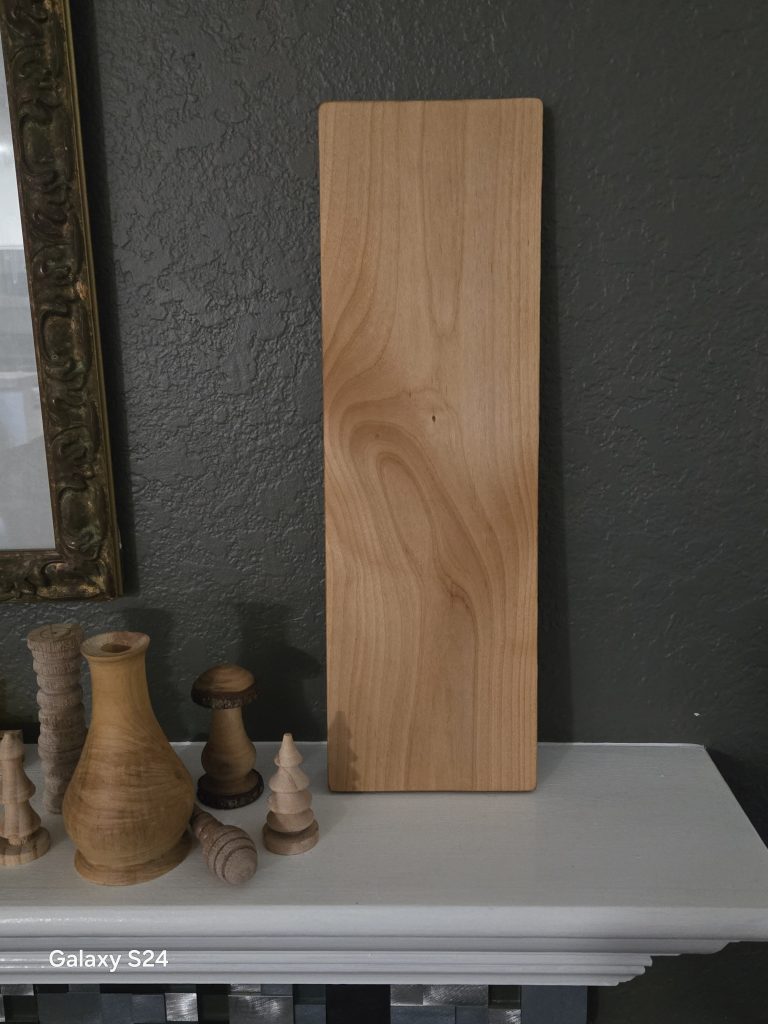
I opened my one Christmas present. It was a piece of wood 4 inches wide, 16 inches long, and 1 inch deep.
“It’s a piece of wood.”
“No, mom, it’s a cutting board.”
“No cutting board is 4 inches wide.”
“It’s portable. You can take it camping.”
“Oh, great! Then it has a dual purpose right? If a bear comes along, I can hit it over the head with my portable cutting board.”
Despite my disappointment, the silliness of it all became the predominant mood. Suddenly, the heaviness of the year lightened immeasurably.
And this has led to my upcoming project to redo the Christmas decorations, to bring them in line with the rest of my decor. And this has become a metaphor for redecorating my heart in preparation for the holiday season of 2026.
Christmas trees often become collections of memories:
- the handmade ornament,
- the kindergarten reindeer,
- Grandma’s angel,
- the souvenir from Disneyland,
- the ugly ornament Aunt Martha loved.
Most of those memories are pleasant. But some are painful. Still they are a record of life. And now my kids are teenagers.
Instead of all new ornaments, I will transform them. I will repurpose them, just as I repurpose memories both pleasant and painful.
When my boys were young, a cohesive color palette was unnecessary. They didn’t care. It was simply an abundant tree. Yet, I saw too much visual noise, too much incoherence.
Recovery isn’t about accumulating more. It’s making decisions about which memories deserve a prominent place in my home, on my tree of abundance. It’s choosing what truly belongs.
Every year we unpack boxes filled with memories.
Some still make us smile.
Some we keep out of obligation.
Some we haven’t looked at in years.
Healing asks a simple question:
Which memories deserve another season?
I have spent the last 12 months editing my life.
Not deleting it.
Editing it.
Keeping:
- relationships that nourish
- traditions that still fit
- colors that bring peace
Releasing:
- visual clutter
- emotional clutter
- obligations
- inherited expectations
My ornaments reflect my identity, and not every ornament belongs on the tree. Some can remain packed away. Not every part of my history deserves equal prominence. Not because I’m in denial. Quite the opposite. I took those memories out, looked at them, analyzed their significance, and put them back in the box.
The boys will head off to camp in a couple of days, leaving me with six quiet nights and a garage full of spray paint, ribbons, preserved greenery, and bins of Christmas ornaments waiting for their makeover. By the time Thanksgiving arrives, I hope the burgundies, deep plums, sapphire blues, timber greens, and antique brass finishes will finally feel like they belong together.
But I already know the most important part of the project won’t be the colors.
It will be the decisions.
Some ornaments will receive fresh paint. Others will stay exactly as they are because they already tell the story I want them to tell. A few may quietly return to the storage box for another year. None of those decisions erase the past. I choose which ornaments to display.
Recovery has never asked me to forget.
It has asked me to choose.
To choose which relationships nourish me.
Which traditions still fit.
Which expectations no longer belong to me.
Which memories deserve to remain on display, and which can be gently wrapped in tissue paper and placed back in the box—not because they are unimportant, but because they no longer define the room.
When people talk about healing from complex trauma, they often imagine becoming someone entirely new.
That has not been my experience.
Healing has felt much more like decorating a Christmas tree.
The ornaments are still mine.
The memories are still mine.
Even the painful ones helped shape the person I have become.
But today I get to decide where they hang.
And then there is one object that will never need repainting or repurposing.
The little “portable cutting board.”
The piece of wood that made me laugh after one of the heaviest years of my life.
The epic prank of a teen boy on his mother.
I still tell him that one day I’m going to mount it on a walnut plaque with a brass plate underneath.
The engraving will read:
Piece of Wood. Christmas 2025.
He rolls his eyes every time I say it.
I laugh every time.
And perhaps that is the greatest gift of healing.
Not that every ornament finally matches.
Not that every painful memory disappears.
But that after years of surviving, there is once again room for laughter beneath the Christmas tree.
Photo Credit: Unsplash
Guest Post Disclaimer: This guest post is for educational and informational purposes only. Nothing shared here, across CPTSDfoundation.org, any CPTSD Foundation website, our associated communities, or our Social Media accounts, is intended to substitute for or supersede the professional advice and direction of your medical or mental health providers. The thoughts and opinions expressed are those of the guest author and do not necessarily reflect the views of the CPTSD Foundation. For further details, please review the following: Terms of Service, Privacy Policy and Full Disclaimer
- About the Author
- Latest Posts

Wendy Hoke writes about complex trauma, dysfunctional family systems, boundaries, faith, and recovery. Her essays combine personal experience with thoughtful exploration of the psychological, relational, and spiritual questions that often follow childhood adversity.
She is the author of The Bishop’s Cross: A Journey to the Truth and co-author of The Church of Gomorrah: When Sexual Abusers Remain in the Church. She lives in San Diego with her two sons and continues to write memoirs, essays, and nonfiction.