Trauma-Informed Blog
New content weekly! Survivor Stories, Research Articles, Poetry, and more written by clinicians, coaches, survivors, and mental health professionals.

Remember...
Important Information About Our Content
Everything you find on this blog, CPTSDfoundation.org, or within our wider digital communities is created for educational and informational use only. No content shared here—whether by our staff or guest contributors—is intended to supersede or replace the clinical relationship you have with your medical or mental health providers. We are here to support your journey with information, but we do not provide medical advice or treatment. Guest opinions are their own and may not represent the views of CPTSD Foundation. Privacy Policy and Full Site Disclaimer, Terms of Service.
Five Habits That Make CPTSD Symptoms Worse
As we struggle with the psychological and neurological effects of trauma in our lives, there are many things about CPTSD that we cannot control. So the things we can control have even more...
Applying Emotional Intelligence to Our Lives
People living with complex post-traumatic stress disorder are notorious for their emotional dysregulation. Emotional intelligence is critically important for controlling one's emotions and surfing...
Gag Me With a Compliment
Why trauma survivors may not be able to receive compliments, praise, or kindness. The funniest thing came to mind when I was thinking about this topic. It was a memory from my childhood of going to...

Trauma-Informed Yoga: Interoception (Our Felt Sense)
Many of us have a superpower survivor skill. We’re able to read the room, scope out the nearest exit, understand what the shuffling footstep means, and instantly react to that slight facial...
Emotional Wellness and Understanding the Effects of Conditioning
As I mentioned in the previous post, I had lived over a half-century, clueless in my own understanding of how emotions worked. In fact, I was absolutely unaware that I was clueless. My life looked...
The Importance of Becoming Emotionally Intelligent
For the past few years, a relatively new phrase has entered the vernacular of psychiatry, emotional intelligence. What is emotional intelligence? How can you achieve it? What are the benefits of...
Off Label Patterns That Reveal Narcissism Part II of III
I want to start the second part of this trilogy by offering you a compliment and that I am convinced because you are here and reading this article because you are wanting to learn. In other words,...
The Selfish Heart – Relational Trauma in Our Family of Origin
You can’t convince a narcissist to lay down their weapons

Understanding Emotional Wellness
When I first started this journey back on Easter of 2012, I had no idea where it would lead me. Somehow it seemed as if I was being led away from a life that had not been right for me and shoved...
The Agony of Abandonment
Nothing can shake the soul of a person more than abandonment. No matter what time of our lives it happens, it is excruciating and life-altering. This article will focus on abandonment and ways to...
Love’s Outrage
When I feel overwhelmed by the toll trauma has taken from my life, I am outraged.
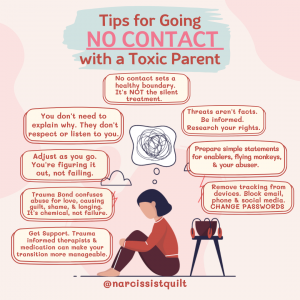
Tips for Going “No Contact” with a Toxic Parent
Going No Contact with toxic parents is hard. Learn how to draw this healthy boundary and protect yourself with these tips provided by the scapegoat of a narcissistic parent.

What is Complex Post-Traumatic Stress Disorder?
“Complex PTSD comes in response to chronic traumatization over the course of months or, more often, years. This can include emotional, physical, and/or sexual abuses, domestic violence, living in a war zone, being held captive, human trafficking, and other organized rings of abuse, and more. While there are exceptional circumstances where adults develop C-PTSD, it is most often seen in those whose trauma occurred in childhood”.